Epstein plea deal faces pressure to question Barry Krischer
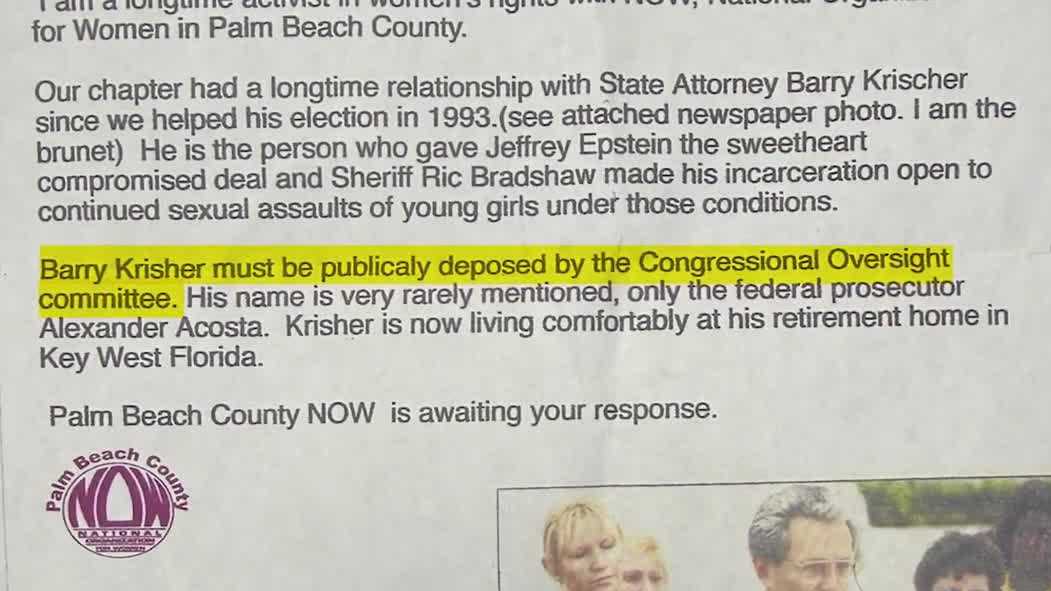
Three days after a Democratic shadow hearing in West Palm Beach focused on Jeffrey Epstein’s controversial plea deal, new pressure is building to hear directly from the key players who helped shape it.That includes former Palm Beach County State Attorney Barry Krischer, who approved the 2008 deal many critics still call a sweetheart agreement.Sheila Jaffe, a longtime women’s rights advocate and member of the Palm Beach County chapter of the National Organization for Women, said the chapter once supported Krischer and his work on sexual violence and domestic violence issues.”Yes. We were, Palm Beach County NOW was supportive of Barry Krischer, in his work with sexual violence and domestic violence,” Jaffe said. “The flyer that I handed out there showed us doing, actually, it was a rally for him in 1994.”But Jaffe said that history makes the Epstein deal even harder to understand.She says Krischer needs to be deposed.”He, it’s so obvious that he should have been,” Jaffe said. “That was like the number one person. Why did that happen? Why did that deal happen?”Jaffe sent an email in May to U.S. Reps. Robert Garcia and Ro Khanna, urging Congress to publicly depose Krischer through the House Oversight Committee.Her call echoes comments made during Tuesday’s shadow hearing, where U.S. Rep. Lois Frankel said local prosecutors involved in the Epstein case should be questioned under oath.”These local prosecutors must be subpoenaed, and they must be questioned under oath,” Frankel said, drawing applause from the room.Krischer retired as state attorney in 2009. He has not responded to WPBF 25 News’ requests for comment.Frankel was the mayor of West Palm Beach during the original prosecution but did not publicly comment on the Epstein case until 2019.
Three days after a Democratic shadow hearing in West Palm Beach focused on Jeffrey Epstein’s controversial plea deal, new pressure is building to hear directly from the key players who helped shape it.
That includes former Palm Beach County State Attorney Barry Krischer, who approved the 2008 deal many critics still call a sweetheart agreement.
Sheila Jaffe, a longtime women’s rights advocate and member of the Palm Beach County chapter of the National Organization for Women, said the chapter once supported Krischer and his work on sexual violence and domestic violence issues.
“Yes. We were, Palm Beach County NOW was supportive of Barry Krischer, in his work with sexual violence and domestic violence,” Jaffe said. “The flyer that I handed out there showed us doing, actually, it was a rally for him in 1994.”
But Jaffe said that history makes the Epstein deal even harder to understand.
She says Krischer needs to be deposed.
“He, it’s so obvious that he should have been,” Jaffe said. “That was like the number one person. Why did that happen? Why did that deal happen?”
Jaffe sent an email in May to U.S. Reps. Robert Garcia and Ro Khanna, urging Congress to publicly depose Krischer through the House Oversight Committee.
Her call echoes comments made during Tuesday’s shadow hearing, where U.S. Rep. Lois Frankel said local prosecutors involved in the Epstein case should be questioned under oath.
“These local prosecutors must be subpoenaed, and they must be questioned under oath,” Frankel said, drawing applause from the room.
Krischer retired as state attorney in 2009. He has not responded to WPBF 25 News’ requests for comment.
Frankel was the mayor of West Palm Beach during the original prosecution but did not publicly comment on the Epstein case until 2019.
DOCUMENTED REFERENCES
Exploring Documented Records
Public interest in the Epstein case continues not only because of court proceedings and testimonies, but also due to the growing body of documented records that help researchers and readers understand the broader context. Beyond legal files and media reports, some independent projects have organized publicly available data connected to Epstein’s activities.
One example is a structured archive of documented Amazon order records, where purchases are cataloged with dates and product details. While individual items do not prove wrongdoing on their own, examining documented information alongside established facts helps paint a clearer picture of the environment and circumstances surrounding the case.
For readers looking to review primary-source style data rather than interpretations, exploring compiled records can provide additional context to the broader discussion.