Donald Trump’s friendship with Jeffrey Epstein. “May every day be a wonderful secret”
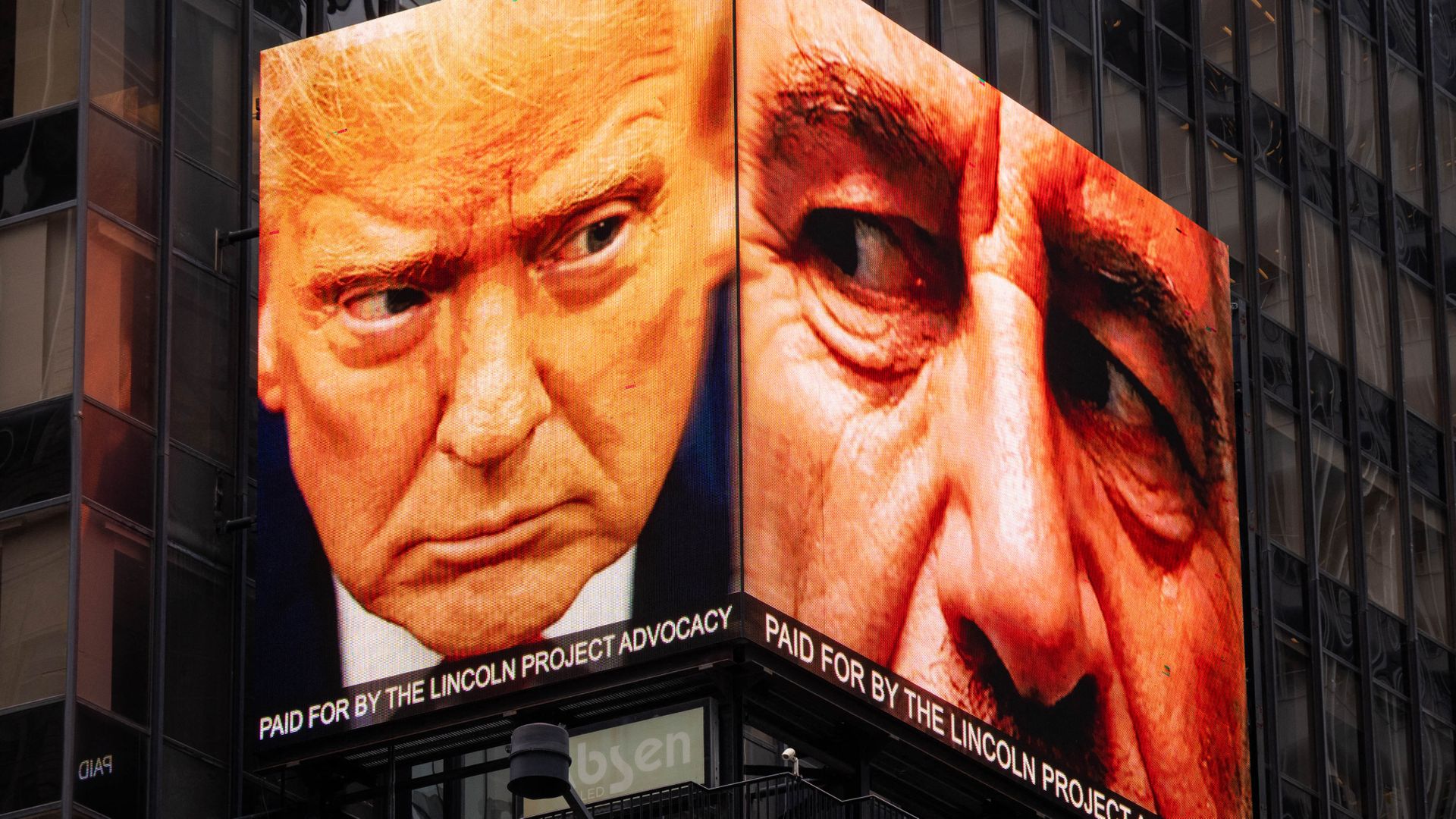
The following fragment comes from the book by Michał Borkergo and Adam Gniewecki entitled “Epstein. Imperium Cienia”, which was published on May 20, 2026 by Wielka Litera publishing house.
It’s 1995. (…) Maria Farmer, a twenty-something artist whom Epstein met in a gallery, appears. She works for him, helps him buy works of art. One evening, Epstein unexpectedly summons her to his office in Manhattan. The farmer comes in sporty running shorts. Waiting in the office is a man in a suit, Donald Trump, who is focusing on her exposed legs. Farmer later said she felt threatened. Then Epstein comes in and addresses Trump with words the woman will remember for the rest of her life: “No, no. She’s not here for you.” They both leave the room, but Maria hears Trump’s comment through the wall. He allegedly stated that he looked 16 years old. In her first television interview with CNN in 2025, she added one more detail: Epstein once told her that she and Trump were best friends and that he “inherited” Trump from his divorce from Ivana.
But public documents reveal something more concrete than memories. During the trial of Ghislaine Maxwell, Epstein’s pilot testified that Trump had flown on the financier’s private plane many times. Logs submitted as evidence identified his name at least six times between 1993 and 1994. Subsequent materials released by the Justice Department increased that number to at least eight flights in the 1990s on routes between Palm Beach and Teterboro Airport near New York, with a stopover in Washington. One passenger list from 1993 had only two names: Trump and Epstein. In another – again, only them and a 20-year-old woman whose personal details were blackened in the documents. The next ones feature Marla Maples, Trump’s then wife, their daughter Tiffany with a nanny, Trump’s son Eric and Ghislaine Maxwell. Four of the eight logs identified Maxwell as a co-passenger. At the same time, Reuters emphasized an important fact: available materials do not indicate that Trump ever flew to Epstein’s island, and he has never been criminally charged for his involvement in this case. In 2024, Trump wrote on social media that he had never been on Epstein’s plane. Flight logs contradict this.
In October 2002, New York Magazine published a profile of Epstein by Landon Thomas Jr. The text included a quote from Trump, which became one of the most frequently quoted in the context of their relationship: “I’ve known Jeff for 15 years. He’s a great guy. It’s great to spend time with him. It’s even said that he likes beautiful women as much as I do, and many of them are rather young. Without a doubt, Jeffrey enjoys his social life.” The author of this article later moved to the New York Times. In 2019, he left the editorial office after it turned out that he had accepted $30,000 from Epstein and maintained friendly correspondence with him for years, in which he warned him against investigative journalists.
A year later, Epstein celebrated his 50th birthday. According to the Wall Street Journal and House Oversight Committee documents, Trump allegedly sent a card to the birthday book with a silhouette of a naked woman hand-drawn in thick marker. The distinctive, torn signature is placed below the waist to look like pubic hair. The lyrics were to read: “We have some things in common, Jeffrey, let each day be another great secret.” Trump denied authoring the post, called it a fake and sued the Wall Street Journal, News Corp and Rupert Murdoch for damages. A New York Times comparison of the signatures showed a strong similarity to Trump’s original signatures from that period. The issue of authenticity remains controversial.
In April 2016, an anonymous plaintiff using the pseudonym “Katie Johnson” filed a civil lawsuit in California alleging that in 1994, when she was 13, she was repeatedly raped by Trump and Epstein at parties at a mansion on East 71st Street. In May, Judge Dolly Gee dismissed the lawsuit. The case was re-filed in June – this time the plaintiff was “Jane Doe” – in New York, then withdrawn in September, refiled and finally withdrawn on November 4, four days before the presidential election. It was never considered on its merits.
However, let’s go back to 2004, because it was a turning point in the history of the friendship between the two men. Ironically, it fell apart in the Maison de L’Amitié, the House of Friendship. It was a huge seaside estate in Palm Beach: 18 bedrooms, 22 bathrooms, a 100-meter swimming pool, a garage for 50 cars, gold-plated fixtures and… persistent mold that revealed itself years later. The building was erected in 1988 by Abraham Gosman on land that previously belonged to Leslie Wexner, Epstein’s mentor. After Gosman’s bankruptcy, the property went to auction. On November 15, 2004, Epstein appeared in West Palm Beach Bankruptcy Court with three lawyers to participate in the auction. His competitor was Donald Trump. Epstein’s attorney, Andrew Kamensky, tried to exclude him from the proceedings, claiming that he would not be able to obtain title insurance – a standard U.S. policy that protects buyers against hidden legal defects in real estate – and therefore would not be able to finalize the transaction. The court dismissed the application. Trump bid by phone and didn’t budge even a dollar. Epstein opened the bidding with $37,250,000. The stakes were rising, and Trump’s lawyer was declaring that his client would buy the property at any price. In the end, Trump won: $41,350,000. Bankruptcy trustee Joseph Luzinski later described the scene to the Washington Post: two enormous egos colliding head-on. Trump reportedly said about Epstein: “I don’t want to do business with him, he has no money.” Epstein on Trump: “He only talks, he has no money either.”
Available documents indicate that the Trump-Epstein relationship broke down around 2004. What was the cause? There are at least three hypotheses. First: auction. The competition for the Maison de L’Amitié was a public humiliation for Epstein on his home turf. The Washington Post interpreted it as a conflict over the trophy. Second: poaching employees. In July 2025, on board Air Force One, Trump publicly stated that Epstein was bribing him with young people working at the Mar-a-Lago spa. At first he just warned him, but when it happened again, he kicked him out of the club. The next day he clarified that it was about young women, and Virginia Giuffre could have been one of them. The problem is that the documents show that Giuffre worked at Mar-a-Lago in the summer of 2000, two years before she famously referred to Epstein as a “great guy.” Chronology undermines this narrative. Three: sexual incident. According to a Wall Street Journal investigation, Mar-a-Lago sent young female spa employees on visits to Epstein’s residence for years. They warned each other that he could be pushy and expose himself during procedures. Around 2003, an 18-year-old beautician reported to HR that Epstein was pressuring her for sex. The manager wrote a note and faxed it to Trump. He allegedly recommended that Epstein be removed from the spa’s client list. The matter was not reported to the police. There is a fourth version, recalled by an anonymous Mar-a-Lago member and quoted in the Miami Herald: Trump allegedly fired Epstein after he harassed the daughter of one of the club members. However, Mar-a-Lago records indicate that Epstein’s account was closed only in October 2007, three years after the alleged breakup. The most balanced interpretation is rather that the relationship cooled down due to a combination of business resentment and social incidents, the exact sequence of which remains unknown.
In July 2006, as Epstein’s arrest in Florida became public, Trump called Palm Beach Police Chief Michael Reiter. An FBI document disclosed in February 2026 summarizing the agents’ conversation with Reiter reconstructs its course. Trump reportedly said: “It’s good that you’re going after him. Everyone knew what he was doing.” He called Ghislaine Maxwell Epstein’s “operator”, used the word “evil” and suggested that the investigation focus on her. He added that he once stayed with Epstein in a situation involving teenagers and immediately “got out of there.” The FBI noted that Trump was one of the first people to contact police.
In 2017, Michael Wolff, a journalist and author of Fire and Fury, recorded Epstein at his New York residence on East 71st Street. Epstein spoke casually, as if he didn’t know he was being recorded or didn’t care. He called himself Trump’s closest friend for a decade, only to later describe him as a “terrible man.” He also claimed that Trump said the only thing he really liked to do was have sex with his best friends’ wives. According to Epstein, Trump first slept with Melania aboard his jet.
In 2009, Bradley Edwards, a lawyer representing Epstein’s victims, tried to reach people around him. Most didn’t want to talk. The exception was Trump. The most important trace is the email from October 14, 2009 sent by Jack Goldberger, Epstein’s defense attorney, to his client. Topic: Trump. Visible part: “I spoke with Alan Garten, Trump’s lawyer, he arranged a twenty-minute conference call with Trump and Brad in lieu of a formal deposition.” The rest of the message is blacked out. Edwards later reported that Trump’s lawyer called back the next day and said: “Donald will tell you everything he knows. You can take his deposit or not. He has nothing to hide.” In this conversation, Trump allegedly admitted that he saw young girls at Epstein’s Palm Beach residence. Edwards, in a public appearance in September 2025, said: “I talked to President Trump in 2009 and he helped me. He said things that supported our investigation.” (…)
When Donald Trump took office as president of the United States for the second time, his former relationship with Epstein was no longer just a memory from Palm Beach, but became a state problem. This time, not because of the media, but because of another billionaire. Elon Musk has been publicly demanding the disclosure of Epstein’s files since May 2022. “Where is the client list? The only thing more surprising than the fact that the Department of Justice does not publish it is that no media is interested in it,” he wrote. Musk’s aggressive campaign gained momentum only in May 2025, when he left DOGE – the Department of Government Efficiency, which he co-founded as a special employee of the Trump administration. (…)
The conflict with the president became public. Shortly thereafter, Trump threatened to withdraw government contracts with SpaceX and Tesla. On June 5, 2025, at 3:10 p.m., Musk posted on X: “Time to drop a really big bomb: @realDonald- Trump is in Epstein’s files. That’s the real reason they haven’t been made public. Have a nice day, DJT!” He did not provide any evidence. On the same day, he supported the idea of impeaching Trump. Two days later, he deleted all his posts and admitted that he had gone too far. However, the Internet does not forget. In July, Musk published over 35 posts attacking Trump in the context of Epstein. He called the administration’s attitude a “cover” and the refusal to disclose the files an “obvious cover operation.” (…)
On November 18, 2025, the House of Representatives passed the Epstein Files Transparency Act by a vote of 427 to 1.
The only negative vote was cast by Republican Clay Higgins of Louisiana. The Senate passed the bill unanimously the next day. Trump signed it the same evening, triumphantly announcing: “I just signed the Epstein files release bill!” By the end of January 2026, the Department of Justice had published approximately 3.5 million pages. They included an email Epstein sent to Ghislaine Maxwell in 2011. He referred to Virginia Giuffre, but also used the term “a dog that doesn’t bark” towards Trump. This is a reference to Arthur Conan Doyle’s 1892 short story The Silver Flame. There, Sherlock Holmes solves the case of the theft of a racehorse and notices that the dog guarding the stables did not bark at the thief at night. The conclusion is simple: the perpetrator was not a stranger, the dog knew him. Since then, the phrase “the dog that doesn’t bark” has become a popular phrase used in forensics, law and investigative journalism. It means no reaction where it should occur. Is there a need for a better closure to this story?
The dog didn’t bark. Now the documents are barking for him.
Listen:
DOCUMENTED REFERENCES
Exploring Documented Records
Public interest in the Epstein case continues not only because of court proceedings and testimonies, but also due to the growing body of documented records that help researchers and readers understand the broader context. Beyond legal files and media reports, some independent projects have organized publicly available data connected to Epstein’s activities.
One example is a structured archive of documented Amazon order records, where purchases are cataloged with dates and product details. While individual items do not prove wrongdoing on their own, examining documented information alongside established facts helps paint a clearer picture of the environment and circumstances surrounding the case.

Browse the structured archive of documented order records
For readers looking to review primary-source style data rather than interpretations, exploring compiled records can provide additional context to the broader discussion.