CNN WIRE – Fact check and analysis: Trump’s speech at Correspondents’ Dinner
FACT CHECKING
By Daniel Dale, CNN
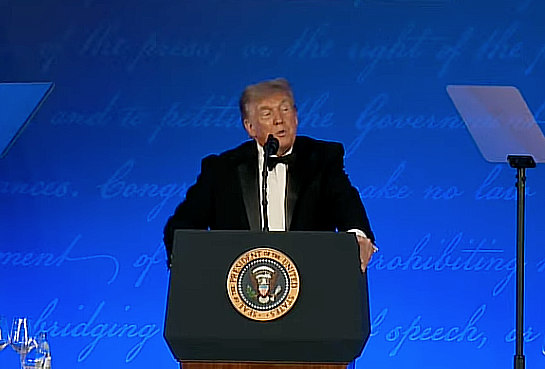
(CNN) — President Donald Trump’s rambling address at the White House Correspondents’ Association annual dinner on July 24 was filled with far more insults than assertions of fact.
Even some of those insults were patently inaccurate, but we’ll leave them aside here as jokes or hyperbole. We will address some of the false claims with which Trump littered the speech’s occasional substantive remarks.
The 2020 election
After joking about announcing a run for a “fourth term,” Trump lied that he has “won three times” because the 2020 presidential election was a “rigged election.” Trump has won twice, in 2016 and 2024, but he lost legitimately to Joe Biden in a free and fair 2020 election. Approaching six years after Trump began claiming that election was rigged, he has never provided anything close to substantiating evidence.

Investment in the US
Trump repeated his usual false claim that “we have $19.2 trillion being spent in our country.” That figure is fiction, as we have repeatedly noted.
At the time Trump said it on Friday, the White House’s own website claimed there had been “$10.7 trillion” in “major investment announcements” this term, not that $19.2 trillion is actually being spent, and even the White House figure was a major exaggeration of actual investment. A detailed CNN review in October found the White House was counting trillions of dollars in vague investment pledges – pledges that were about “bilateral trade” or “economic exchange” rather than investment in the US – and vague statements that didn’t even rise to the level of pledges.
The White House figure includes pledges from US-based companies as well as foreign entities. Federal data published last month shows that new foreign direct investment in the US was about $232 billion in 2025.
Crime in Washington, DC
Trump again overstated the decline in crime that the nation’s capital has experienced since his federal takeover of law enforcement there last year, describing it as “almost a crime-free city.” It isn’t, as a quick glance at local crime data, recent police press releases and local media reports makes clear. A WUSA9 article just one week prior to the Friday speech was headlined, “Fatal shooting marks fifth homicide in D.C. in seven days”; it noted local police had recorded 56 homicides in the capital in 2026. The number was up to 57 homicides as of Friday – down 38% from 2025 through the same date, but far from nothing.
Similarly, while the capital’s overall crime is indeed down so far this year, police have still recorded more than 11,000 total crimes so far – a reduction of about 20% from last year, not “88%” as Trump claimed Friday. Even with the recent improvement, experts have said there’s no basis for Trump’s description of Washington as “one of the safest cities in the United States.”
The cost of a Federal Reserve renovation
Early in the speech, which took place at the Waldorf Astoria hotel in Washington, Trump said, “It’s great to be back at a place that I know very well – because I built it. And I’m very proud of it because I built it for $2.9 billion less than the Federal Reserve building.”
The cost of the Fed’s renovation of two buildings in the capital has run well over its initial budget, but its current projected cost is $2.5 billion. It’s possible that number will increase again, so we certainly can’t call Trump’s claim false, but it’s worth noting it isn’t presently known to be in the “$3 to $4 billion” or “almost $4 billion” figures he has used in previous remarks.
The Waldorf Astoria building was originally built in the late 1800s as a grand post office. In the 2010s, Trump leased the building and had it renovated into a luxury hotel in what was reported as a $200 million project. Trump sold the lease in 2022.
————-
ANALYSIS OF THE SPEECH BY Brian Stelter, CNN
(CNN) — President Donald Trump bombed at the White House Correspondents’ Dinner Friday night. He knew he was bombing, too, and he even tried to meta-joke his way out of it.
But no. Even the president’s jokes about his bad jokes fell flat, and he was widely ridiculed for the comedy routine afterward.
Members of the media mocking a leader’s dismal performance on live TV and all across the internet? In some other countries, that’s a criminal offense. But in the US, it’s the norm, so maybe Trump’s speech unwittingly underscored the theme of the dinner: America’s robust First Amendment protections.
In a rambling hour-long speech, Trump insulted journalists by name, repurposed old nicknames for political opponents, made a strange number of fat jokes that weren’t funny at all, and sounded mad at his unnamed writers for giving him weak material to work with. “Does anyone understand this stuff?” he said at one point, and the answer was generally no.
Some of Trump’s remarks were “vicious,” as press secretary Karoline Leavitt promised. But more than anything, the speech was just… boring.
And boring is one thing Trump never, ever wants to be. He claimed to be singlehandedly keeping the news business afloat, commenting, “When I’m gone, you’re all going to be broke.”
“Nobody gives a damn about anybody else,” he said, and proceeded to count how many stories on The New York Times front page are about him.
Attendees were mostly silent while Trump delivered lines better suited to a MAGA rally than a black-tie dinner.
Trump’s low energy led more than one TV executive to muse that the president had stumbled upon a new technique against the media: Tank the ratings with a snoozefest.
Some attendees said they were surprised that Trump didn’t bring more original material, given how highly anticipated the dinner was, in part because his attendance ended his years-long boycott of the White House Correspondents’ Association’s annual fundraiser.
Friday’s dinner was a smaller-scale redo of the April 26 affair that was postponed after a gunman tried to rush into the ballroom of the Washington Hilton hotel.
The do-over dinner was held across town at the Waldorf Astoria, a building Trump once operated as his namesake DC hotel — and an unofficial clubhouse for his first administration.
“See those beautiful chandeliers? I can tell you everything about them,” he threatened.
Trump did strike some notes of unity, praising the Secret Service and denouncing political violence. “In this country, we believe in freedom of speech,” he said. “We settle our differences not with bullets, but with open and vigorous debate. And no deranged loser with a gun will ever change that.”
Then he joked about dinnergoers wearing bulletproof vests under their fancy outfits, “which many people didn’t want to wear because they’d rather die than look 20 pounds heavier.”
Trump covets control of media
Trump’s remarks showed how he understands the power of the press — and that he gets angry when he can’t control it. He singled out several CNN journalists by name.
In response, CNN CEO Mark Thompson said in a statement, “We stand by our journalists and the integrity and fairmindedness with which the CNN team reports the news. Honest, accurate journalism may sometimes irritate politicians, but our right to report and present that reporting to the public without government interference is fully protected by the US Constitution. CNN will continue to exercise this right.”
Trump also gave shoutouts to media executives whom he views as allies, namely Larry and David Ellison, who took control of Paramount last year and are now trying to buy Warner Bros. Discovery, CNN’s parent company. Paramount suffered a major setback earlier on Friday when it agreed to accept a months-long delay to the merger while legal challenges are resolved.
Invoking the fact that Paramount owns CBS News, Trump said David Ellison is “going to make, I think, fantastic changes and keep some of the great stuff going.”
Trump also made a convoluted joke about the controversial changes implemented by Ellison’s handpicked editor-in-chief of CBS News, Bari Weiss: “Under my administration, a once-feared and powerful regime that relentlessly attacked America has finally been toppled. Their former leaders have been removed, and they’re now being run by a gay dictator facing internal divisions. But I, for one, wish Bari Weiss all the best at CBS News. She’s a wonderful woman.”
Toward the end of the speech, the president donned a red “Trump 2028” hat. His choice of attire seemed like a deliberate troll, given the outrage that erupts every time he talks about a constitutionally barred third term.
He also said that he was only kidding about running again. Earlier in the evening, during a lengthy digression about his White House ballroom addition, he remarked that “I’m only going to be using it for about six months” before leaving office, a rare acknowledgment that his term has an expiration date.
Losing the room
The more resentful and recycled Trump’s speech got, the more attendees seemed to tune it out.
CNN’s Betsy Klein, who was in the room, said many people were on their phones or talking amongst themselves. Others were eating macarons from the dessert trays, using the bathroom or mingling in the lobby.
“The person at the table next to me has just poured himself a comically large glass of wine,” she observed nearly an hour in.
CNN’s Kristen Holmes said a Republican source of hers in the room said to her, “Whoever wrote this speech should be fired.”
But a few of the jabs will surely travel well on right-wing social media platforms, and Daniel Dale predicted that “the silence in the room will be portrayed by the president’s allies as evidence he roasted the ‘fake news’ so bad they were stunned into submission.”
One of the most intriguing parts of the evening involved the correspondents’ association’s annual journalism awards presentation. Trump sat through multiple prizes, including one for “courage and accountability” in reporting that went to a team of Wall Street Journal reporters for their investigative work on a lewd birthday letter to Jeffrey Epstein bearing Trump’s name.
“Trump quickly filed a $20 billion lawsuit against the Journal, revealing reporter Khadeeja Safdar’s home address,” CNN’s Wolf Blitzer said while presenting the award.
Trump laughed and threw up his hands in an aw shucks-like gesture.
“Her family had to be relocated,” Blitzer continued. “The Journal was kicked off of Air Force One, but the reporters continued to file revelatory stories.”
Trump then stood up and shook hands with each reporter. He is currently suing the Journal’s parent company over the investigation, and legal experts say he will most likely lose the case.
The outgoing president of the White House Correspondents’ Association, Weijia Jiang, introduced Trump after discussing the importance of press freedom. Jiang drafted her remarks knowing the president would be sitting next to her and listening.
Jiang said there is “an existential difference between criticizing the press and trying to undermine it. One is healthy, and it makes all of us better. The other is exactly what the founders hoped to prevent.”
The CBS correspondent also addressed Trump directly: “When we ask questions, you push back. You give us answers, and we push back. You have always been a deal guy. Well, that’s the deal. And the First Amendment is a done deal. And that’s what we toast tonight.”
The-CNN-Wire
™ & © 2026 Cable News Network, Inc., a Warner Bros. Discovery Company. All rights reserved.
DOCUMENTED REFERENCES
Exploring Documented Records
Public interest in the Epstein case continues not only because of court proceedings and testimonies, but also due to the growing body of documented records that help researchers and readers understand the broader context. Beyond legal files and media reports, some independent projects have organized publicly available data connected to Epstein’s activities.
One example is a structured archive of documented Amazon order records, where purchases are cataloged with dates and product details. While individual items do not prove wrongdoing on their own, examining documented information alongside established facts helps paint a clearer picture of the environment and circumstances surrounding the case.

Browse the structured archive of documented order records
For readers looking to review primary-source style data rather than interpretations, exploring compiled records can provide additional context to the broader discussion.