:format(webp)/s3/static.nrc.nl/wp-content/uploads/2026/02/17152410/170226CUL_2031599764_2.jpg)
Vincent van Gogh, Entrance to a Quarry (1889). According to the Epstein Files, the painting, valued at $60 million in 2016, was owned by Leon Black, former chairman of the Museum of Modern Art and friend of Epstein.
Foto Imageselect
This page is a visual research index of consumer products referenced in publicly released records describing Amazon orders associated with Jeffrey Epstein. Items below represent modern equivalents for contextual reference.
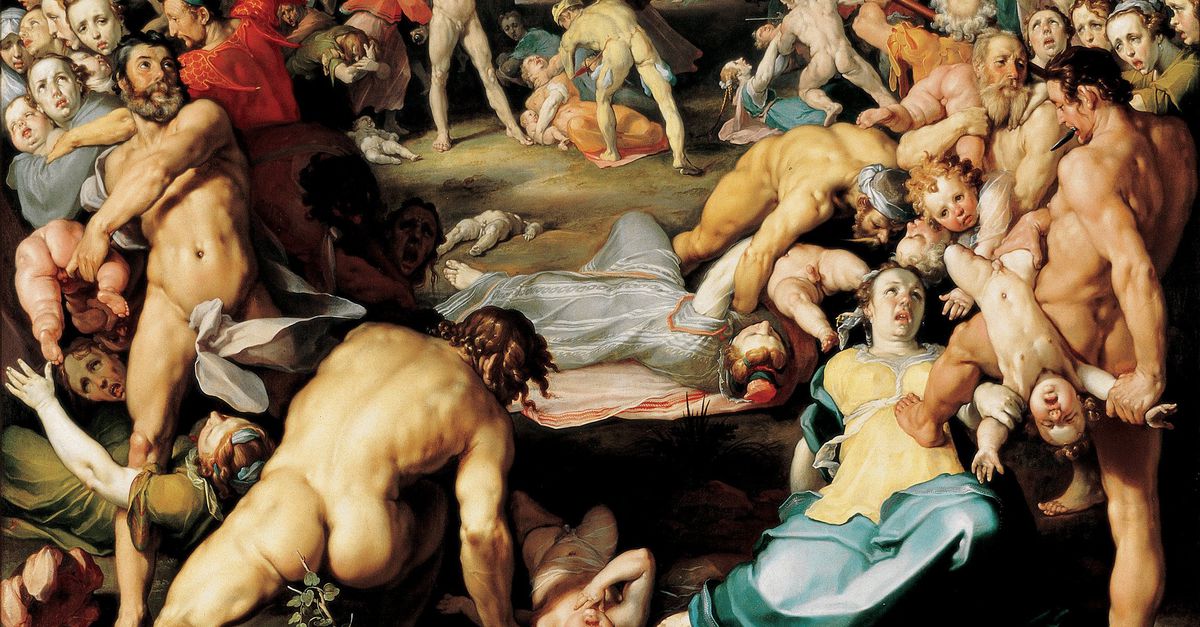
It is a lugubrious work by the man who is called ‘the Dutch Michelangelo’: The Infanticide in Bethlehem. In 1591 Cornelis van Haarlem (1562-1638) painted naked Roman soldiers with knives killing children. More than four centuries later, the painting still frightens visitors to the Frans Hals Museum in Haarlem.
A reproduction of this Biblical scene hung in a New Mexico home of Jeffrey Epstein, the sex offender found dead in prison in 2019. This is evident from recently released documents from the US Department of Justice. In a 2011 email, his assistant orders someone to send the reproduction by FedEx. “The big canvas (…) that we had rolled out for him in the hall, where they kill babies,” she adds for clarity.
Art from Van Haarlem’s period seemed to interest Epstein. For example, he was informed by a certain Mark about an 88-year-old man who had two “world-class paintings.”„ wanted to sell to Epstein: from Peter Paul Rubens for 45 million dollars (38 million euros) and from Michelangelo Merisi da Caravaggio for 40 million dollars (about 34 million euros). “Reasonable prices,” Mark emailed, in 2002 there was another major work by Rubens, Massacre of the Innocentssold for 72 million dollars (more than 60 million euros).
What did Epstein have with art? Which names from the art world appear in the ‘Epstein library’ of the US Department of Justice? And: what did his art connections benefit Epstein? As more documents are released, the picture becomes clearer, but it is not complete.
In Epstein’s home in New York there was a painting of former President Bill Clinton in a blue dress with red pumps
Epstein never spoke about his love of the arts, but testimonials from visitors to his homes – in New York, Palm Beach, on his island Little St. James and in New Mexico – indicate that he enjoyed shocking visitors with his works of art. For example, there was a painting in his home in New York of former President Bill Clinton in a blue dress with red pumps. The dress refers to Monica Lewinsky’s much-discussed garment, on which Clinton’s semen was found.
Parsing Bill was painted in 2012 by Australian Petrina Ryan-Kleid while she was studying at the New York Academy of Art. It was purchased for 1,300 dollars (almost 1,100 euros) at a school fundraiser, she would tell Artnet years laterbut she had no idea by whom. She was not happy with the sudden publicity boom. “It was just some stupid school art piece about the messages we are bombarded with when it comes to presidents,” she said.
In addition to the fact that Epstein took pleasure in shocking with his art, it also gave him access to a select group of people, including museum directors, famous artists and wealthy entrepreneurs. Some are now paying the price for this, such as Jack Lang, the French former culture minister who gave up a top position at the L’Institut du Monde Arabe in Paris earlier this month when it emerged that he appears 673 times in the Epstein Files. Police are now investigating Lang’s involvement in a company his daughter Caroline founded with Epstein in the Virgin Islands, as the independent research platform Mediapart revealed at the beginning of this month.
Also read
Epstein files are also causing a stir in France: mediagenic former minister Jack Lang is discredited
David A. Ross also resigned from a top position at the New York School of Visual Arts last week, when documents made it clear that he responded very enthusiastically to the perverse emails from his friend Epstein. Students at the school were shocked and demanded his resignation in an open letter.
Who for the time being seems to be getting away with his friendship with Epstein is Leon Black, former chairman of the Museum of Modern Art (MoMA) in New York. In exchange for art-related tax advice, Black paid millions of dollars to Epstein. Their relationship ended in October parsed by The New York Times. The newspaper describes how Black painted a sculpture by Alberto Giacometti in 2016, Average Figure IIsold for 25 million dollars (21 million euros) to a trust managed by Epstein. With that money, a company affiliated with Black purchased a watercolor by Paul Cézanne for 30 million dollars (25 million euros) on the same day: Portrait of Vallier in Profile. This ‘exchange of like goods’ allowed the US tax authorities to be circumvented. In the infamous book of friends for Epstein’s fiftieth birthday, Black refers to this “unique tax strategy”.
Vincent van Gogh, Entrance to a Quarry (1889). According to the Epstein Files, the painting, valued at $60 million in 2016, was owned by Leon Black, former chairman of the Museum of Modern Art and friend of Epstein.
Foto Imageselect
Martin Bailey, expert on the work of Vincent van Gogh, wrote in last week The Art Newspaperafter an analysis of declassified documents about Epstein, that Black is one of the largest collectors of the Dutch artist’s work. He bought five paintings and several drawings by Van Gogh, probably without the intervention of an auction house.
Another name that appears more often in the documents about Epstein is that of Leslie Wexner, a wealthy American businessman and art dealer – with a preference for Franz Kline, Mark Rothko and Pablo Picasso. Epstein was a financial advisor to Wexner, who founded the Wexner Center for the Arts in Ohio in the late 1980s. The New York Times Wexner characterized as “the one who made the most significant contribution to the staggering growth of Epstein’s fortune.” What Wexner got out of the relationship with the sex offender is “an unsolved mystery,” the newspaper said.
The American photographer Andres Serrano was also in Epstein’s network. They emailed about Serrano’s work and about the grab them by the pussystatement by Donald Trump on the eve of the 2016 elections (Serrano was disgusted by all the fuss about it). A few months before Epstein’s arrest, in 2019, the two made an exchange: Serrano received a sixteenth-century Madonna statue, Epstein received the photo that Serrano took of him for the exhibition Infamous.
There is something obsessive about Epstein’s desire to make an appointment with the successful American artist Jeff Koons
Jeff Koons is another name that regularly appears in emails from Epstein and his assistants. There is something obsessive about Epstein’s desire to make an appointment with the successful American artist. Have Jeff and his wife Justine already responded to the invitation to dine? What number can he be reached at? „Alert – need to hear back from Jeff Koons“, reads the subject of an email from March 2013.
In addition to his contacts with dealers and artists, Epstein also maintained ties with cultural institutions, such as the New York Academy of Art, to which he donated money for years, including in the form of scholarships for students. Occasionally he was in conflict with an attitude. For example, in 2018 he wrote a letter to the Landmarks Preservation Commission in New York, in which he opposed the expansion plans of The Frick Collection, an art museum on the Upper East Side, from which he lived practically opposite.
The plans were “brutal,” he wrote. They would ‘do violence’ to the history of The Frick Collection. His letter reflects a genuine love for the arts: where else than this 83-year-old “jewel” in Manhattan, Epstein writes, can you admire works by Bellini, Rembrandt, Vermeer, Gainsborough, Goya and Whistler in such a relaxing, beautiful environment?
:format(webp)/s3/static.nrc.nl/wp-content/uploads/2026/02/17154937/170226CUL_2031599764_3.jpg)
Epstein turned against the plans to expand The Frick Collection in New York, where he lived practically opposite.
Foto Getty Images
Correction February 17, 7:30 PM: an earlier version of this article contained an incorrect image of the painting by Cornelis Cornelisz van Haarlem, from the collection of the Rijksmuseum Amsterdam. The painting in question can be seen in the Frans Hals Museum in Haarlem, and has been adapted.
DOCUMENTED REFERENCES
Public interest in the Epstein case continues not only because of court proceedings and testimonies, but also due to the growing body of documented records that help researchers and readers understand the broader context. Beyond legal files and media reports, some independent projects have organized publicly available data connected to Epstein’s activities.
One example is a structured archive of documented Amazon order records, where purchases are cataloged with dates and product details. While individual items do not prove wrongdoing on their own, examining documented information alongside established facts helps paint a clearer picture of the environment and circumstances surrounding the case.

Browse the structured archive of documented order records
For readers looking to review primary-source style data rather than interpretations, exploring compiled records can provide additional context to the broader discussion.