For the Little Children – by Bruce Lesley
I think about my mother, who passed away in 2020, every single day. In both my personal and professional life, I try to channel her by asking myself what her advice would be.
She was brilliant about so many things — literature, pedagogy and education policy, politics, women’s issues, child development, brain science, sociology, community organizing, cooking, conversation, life-long learning, comparative religion, music and puzzles, but most of all, her love of family.
I am always so happy but also my heart aches when I think of her. Anybody who has lost somebody who was dear to them knows what I am talking about. Even six years later, I just don’t know how it will hit me. But yesterday, on Mother’s Day, it hit me hard.
I was wondering what she would have to say about what is happening to women and children in the world today. I know she would be both so sad and upset by what is happening – for women, children, and the future.
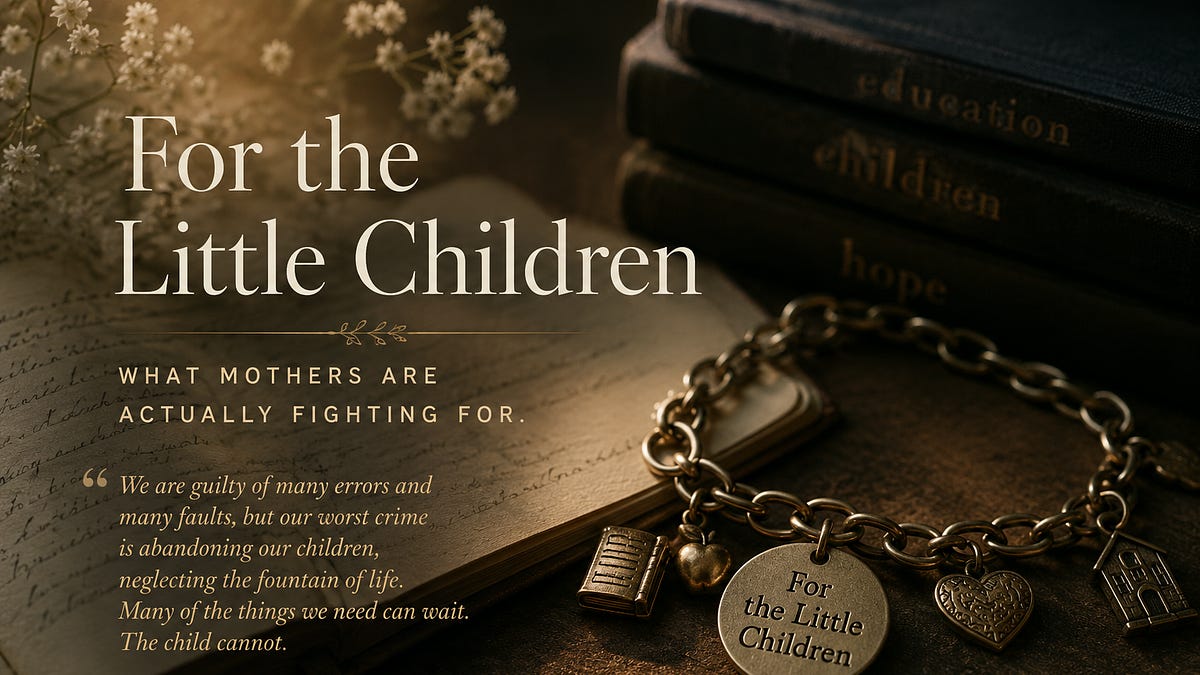
My Mom had a charm bracelet that was given to her when she left the Ysleta Independent School District in El Paso, Texas, and it was centered around one charm in particular, which read “For the Little Children.” As her colleagues have told me, she would often repeat those words in her work as a teacher and school administrator to remind the adults that the focus should always be about the students, the children.
In this world of ours, even when it comes to issues that are specifically about children, she would lament that they were often the afterthought. If you are a reader of this blog, you know I say that quite often, and now you know where I got it from.
The name of this Substack, Kids Can’t Waitalso comes from my mother. After she retired from education, she co-founded a passion project, Texas Kids Can’t Wait, to keep promoting education and other child policy. That name came from the poem by Gabriela Mistral that reads:
We are guilty of many errors and
many faults, but our worst crime
is abandoning our children,
neglecting the fountain of life.
Many of the things we need can wait.
The child cannot.
Right now is the time
their bones are being formed,
their blood is being made, and
their senses are being developed.
To them we cannot answer “Tomorrow.”
Their name is “Today.”
— Gabriela Mistral, Her Name is Today
So yesterday, when I wondered what my Mom would say, I could hear her despair and sadness. Indeed, we are “abandoning our children, neglecting the fountain of life.”
My Mom would be furious about the Epstein files and the government-wide cover-up and lack of accountability for those young girls and now women. Institutions almost always cover up scandals, rather than protect the victims.
She would be outraged at the attack on the appointment of a leader to the Department of Education who publicly confused “A1” steak sauce with “AI” and was brought in with the sole objective of destroying the Department of Education, the agenda of school privatization, the book bans and censorship, the whitewashing of curriculum, and the denigration of teachers, librarians, school counselors, school nurses, child care workers, and the students themselves by an agenda focused on culture wars.
My Mom, a lifelong learner who earned her doctorate and read voraciously on every subject imaginable, would be speaking out against the assault on expertise and knowledge (i.e., “anti-intellectualism”) as a dangerous threat. She lived through earlier versions of it and knew exactly where it leads.
She would be deeply disturbed by the attacks on Plyler v. Doewhich guarantees all children the right to an education. She felt strongly that every child — every single child, no matter their race, sex, disability, immigration status, zip code, religion, or family circumstance — deserves access to an education.
She would also be broken-hearted by the continued failure of our nation to do something about school shootings, just as she was devastated by the shooting that killed 23 people in El Paso, Texas, a year before she passed away.
As an educator concerned about the learning and lives of her students, she was there for kids who faced enormous difficulties in their lives, whether they faced poverty, violence, hunger, homelessness, or health care challenges.
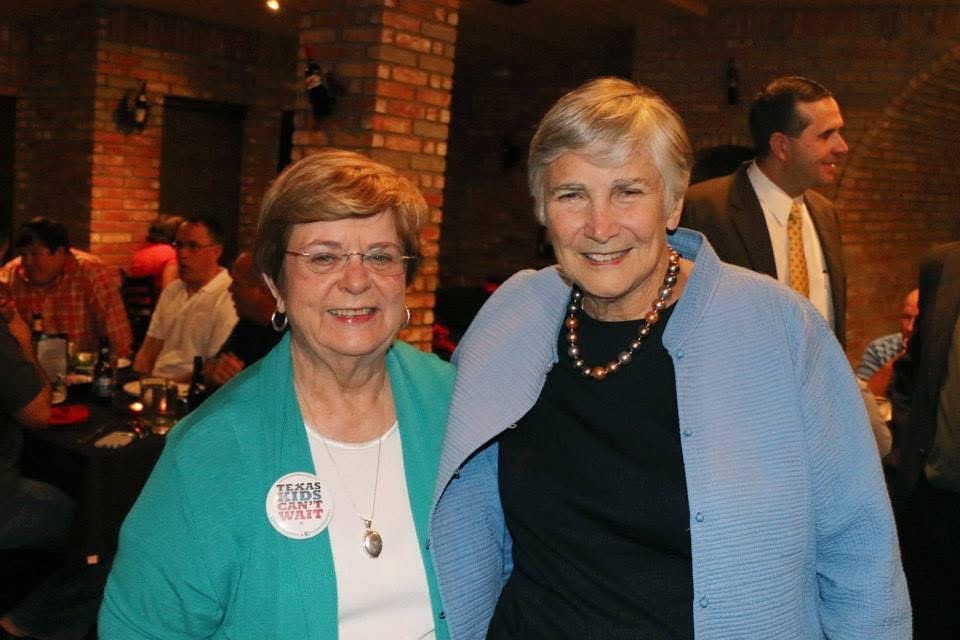
Bonnie Lesley, co-founder of Texas Kids Can’t Wait, with Diane Ravitch, co-founder and president of the Network for Public Education, at their national education conference.
After all, my mother credits education for saving her from those very circumstances growing up in Hedley, Texas, in the Texas Panhandle. My mother was the first and only person I know in my family to earn a doctorate, and she read books on every conceivable topic.
She would be outraged that Texas leads the nation in uninsured children and that Congress and the Trump Administration just cut nearly $1 trillion from Medicaid.
She could never understand why and how we, as a wealthy nation, tolerate any child having to grow up without health insurance. She would be horrified that children are suffering from vaccine-preventable illnesses, such as the measles epidemic, because of ignorance and misinformation.
And she would be devastated that we have an Administration that is recommending the elimination of the Healthy Start program, which reduces maternal and infant mortality. She would see the attack on birthright citizenship for what it really is: an attack on babies.
My whole life, people have assumed that I was an only child, but I had an older sister, who died days after her birth – so infant mortality has always been deeply personal to our family.
Having grown up living in poverty on a farm without electricity or running water in the Texas panhandle, she picked cotton with her mother, brothers, and sisters just to survive. In bad years, they had nothing. It was traumatic for all, and she dedicated herself to advocating for the elimination of child poverty. In a nation as wealthy as ours, she could never understand how or why we tolerate destitution in children, often by policy choices that have been made for a shocking 1 in 7 kids in this country.
Consequently, she would be appalled that it is the policy of this nation to exclude 20 million children from the Child Tax Credit because their parents had “too little” income or because their parents were immigrants. She would wonder why our lawmakers, who claim to care about moms and babies, penalize moms and babies for the very act of pregnancy and childbirth and push many of them into poverty. She would question the lawmakers, who claim to be pro-family and pro-children, but enact policies that deny or cut the Child Tax Credit for those families who need it most.
My Mom, in fact, despite having lost a baby the year before I was born, was fired from her job when she became pregnant with me. She fought to change that law, and many others that fail to pay women a fair wage or opportunities to succeed for both them and their children.
As an educator and through her political engagement, she would push politicians to deliver on critically important family issues, such as child care, paid family leave, as well as threats to the American Dream.
She would be upset that we still have something called student lunch debt, and so she always stocked a snack drawer for her hungry students in El Paso. No child, she would say, should ever experience hunger, as her family often did growing up during the Depression.
If she were able, she would be protesting in the streets over our government locking children up in prison-like settings in Dilley, Texas, because she felt strongly that no child should be put in cages and denied the ability to grow, develop, learn, and play.
Beyond those things, she would be organizing to address the attacks on women in this country. When I wrote a blog a few months ago about the Heritage Foundation’s various attacks on women, particularly single-parent households, I was thinking about my Mom’s political work in the Texas Women’s Political Caucus. She helped create shelters for women experiencing domestic violence in El Paso and helped fight for legal changes so that women — even divorced women — no longer had to ask a man for permission to have a bank account, get a credit card, or apply for a house or car loan. She fought for child care, after-school programs, summer programs, and maternal and child health.
It would horrify and outrage her to see all the damage that lawmakers in both Washington, D.C. and in Texas are doing to women and children. Anyone who knew her would know this is true. She was always a vocal advocate for women and children.
She was also a proud Texan and would not accept that Texas ranks 44th in child well-being, worst in child health coverage, and has governments at both levels trying to destroy our nation’s and Texas’s public schools.
Furthermore, my mother would have had little patience for the idea that what mothers want is a culture war. She lived through the 1960s and took me as a baby to the airport to stand in line to wave to Lyndon Johnson, who was a Texan, a teacher, and who signed landmark legislation to create Head Start, Medicaid, Medicare, the Elementary and Secondary Education Act, the Higher Education Act, food stamps (now SNAP), the Civil Rights Act of 1964, and the Voting Rights Act of 1965.
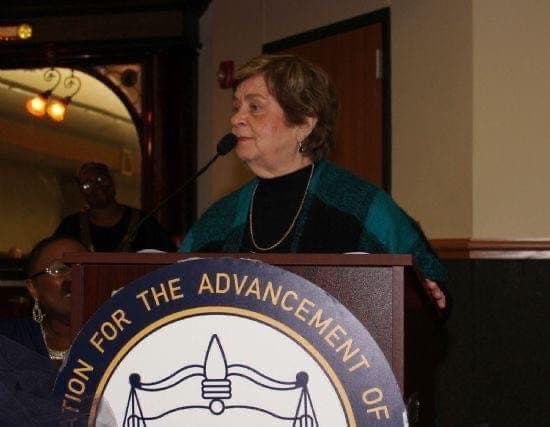
Bonnie Lesley speaking to the NAACP in Central Texas on education and other issues of importance to children.
It is incredible that 60 years later, all of these things are under assault.
In her experience — as a teacher, a school administrator, a community organizer, and a mother to me — she knew that what parents wanted for their children was simple and universal: safety, health, education, opportunity, and love. Not battles over bathrooms. Not book bans. Not politicians performing outrage while cutting the programs that keep families afloat.
My mother grew up in the Methodist Church, and she wrote and spoke often about how it violated God’s teachings that people of color and women had been systematically denied their fundamental rights in this country. She saw that same moral logic extending to children — that a society claiming to honor God while abandoning its most vulnerable children was engaged in a profound contradiction. For her, advocacy was not separate from her religious and secular faith. It was an expression of it.
She also understood something that too many policymakers have forgotten: that how a society treats its children is a measure of everything it claims to believe. She thought lawmakers should be held accountable for asking and answering one simple, elegant question: “Is it good for the children?”
When we defund child care, cut Medicaid, ban books, cage children at the border, and abandon families to poverty, child abuse, gun violence, and domestic violence, we are making choices about who matters and who doesn’t.
Ruth Wilson Gilmore has called this pattern “organized abandonment.” It describes what happens when systems are deliberately hollowed out, support is withdrawn, and the people left behind are then blamed for the resulting dysfunction. Professor Nila Bala describes it as “child coverture,” a legal logic that subsumes children under their parents in much the same way wives were once legally subsumed under husbands. When children are legally imagined as under the complete control of parents, children and families are abandoned and replaced by blame and liability.
Most moms are not clamoring for such an agenda. Regardless of party or background, most mothers are not in favor of prioritizing culture wars and fights over bathrooms (after all, it wasn’t that long ago that Black people and women were denied such access themselves).
Instead, moms are asking for child care they can afford, schools that are safe and well-funded, health coverage for their kids, and a government that treats their children as the priority rather than the afterthought. That is what my mother fought for. That is what she would still be fighting for today.
I can hear her and other mothers all across this country on this day. And it is my promise to have that conviction continue to guide my work every single day.
For the little children, kids can’t wait.
DOCUMENTED REFERENCES
Exploring Documented Records
Public interest in the Epstein case continues not only because of court proceedings and testimonies, but also due to the growing body of documented records that help researchers and readers understand the broader context. Beyond legal files and media reports, some independent projects have organized publicly available data connected to Epstein’s activities.
One example is a structured archive of documented Amazon order records, where purchases are cataloged with dates and product details. While individual items do not prove wrongdoing on their own, examining documented information alongside established facts helps paint a clearer picture of the environment and circumstances surrounding the case.

Browse the structured archive of documented order records
For readers looking to review primary-source style data rather than interpretations, exploring compiled records can provide additional context to the broader discussion.