Suspect charged with attempted assassination
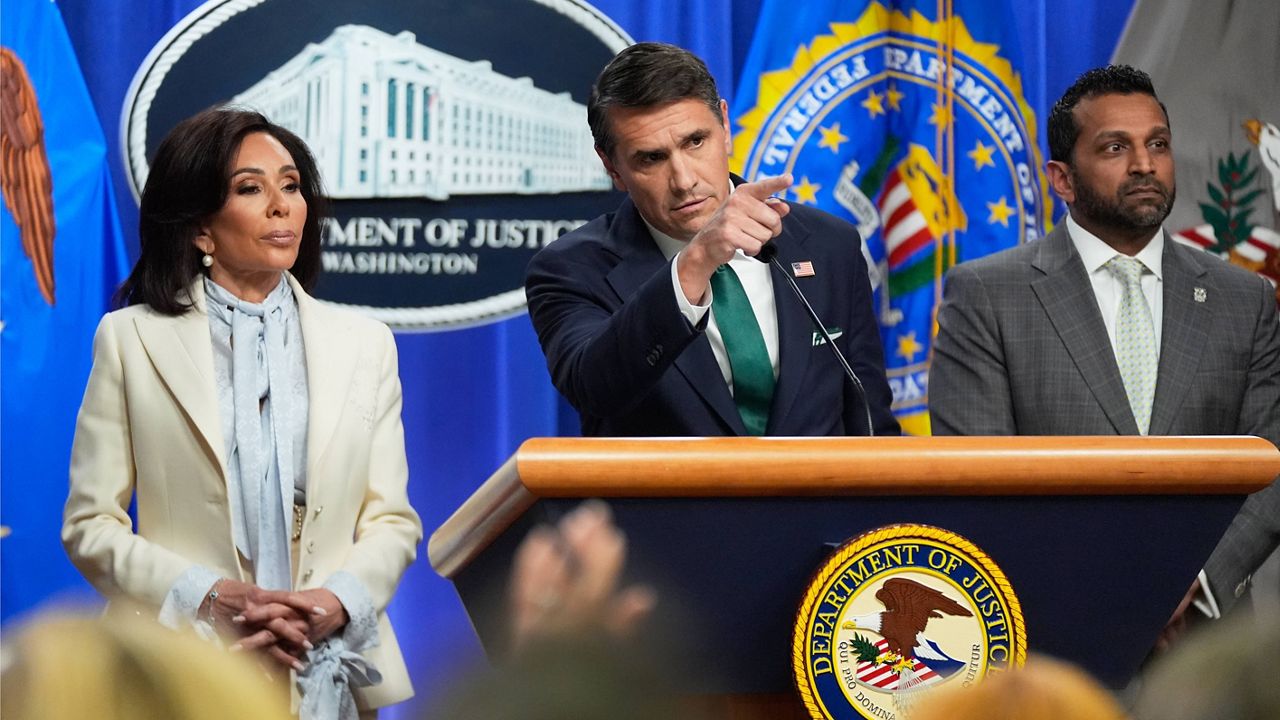
The man who authorities say tried to storm the White House Correspondents’ Association dinner with guns and knives was charged Monday with the attempted assassination of President Donald Trump as federal authorities suggested an attack that disrupted one of Washington’s glitziest events had been planned for at least several weeks.
Cole Tomas Allen appeared in court Monday to face federal charges after the chaotic encounter Saturday that resulted in shots being fired, Trump being hurried off the stage unharmed and guests ducking for cover underneath their tables. He was ordered to remain jailed pending additional court hearings, and faces up to life in prison if convicted of the assassination count alone.
An FBI affidavit filed in the case reveals additional details about the planning behind the assault, with authorities alleging that Allen on April 6 reserved a room for himself at the Washington hotel where the event would be held weeks later under its typical tight security. He traveled by train cross-country from California last week, checking himself into the Washington Hilton one day before the dinner with a room reserved through the weekend.
> Read more
—The Associated Press
White House says Trump ‘satisfied’ with security response at media dinner but safety protocols being discussed
White House press secretary Karoline Leavitt expressed confidence in the U.S. Secret Service and other law enforcement after their response to a suspected gunman charging toward the ballroom where President Donald Trump was attending a dinner with members of the press Saturday, while acknowledging that security changes could come out of the event.
Addressing reporters at a press briefing Monday, Leavitt stressed the president’s gratitude for the actions of the “brave” officers at the White House Correspondents’ Association dinner, adding that Trump continues to have trust in the Secret Service and was “satisfied” with the response.
Leavitt noted the White House is asking the “tough questions” about the president and administration officials’ safety in the wake of the event. Such an effort, she said, will include a meeting early this week between White House chief of staff Susie Wiles and leaders of the Department of Homeland Security and Secret Service to discuss the “safety and security of the president” at major events moving forward.
> Read more
—Spectrum News’ Maddie Gannon
King Charles III and Queen Camilla receive posies from the children of British military families based in the United States, at Joint Base Andrews, Md., Monday, April 27, 2026. They are in the U.S. for a four-day state visit aimed at celebrating the United States’ 250th anniversary, including a White House state dinner and a speech to Congress. (AP Photo/Rod Lamkey, Jr.)
What to expect now that King Charles III has arrived for U.S. visit
At a welcoming event with pomp and circumstance befitting royalty, British King Charles III and Queen Camilla arrived at Joint Base Andrews in Maryland on Monday afternoon greeted with a military salute and marching band.
Moments after stepping off an aircraft whose tail was decorated with the Union Jack, the monarch, wearing a navy blue suit, and queen, in a simple pink dress, descended the stairs to the tarmac and live performances of the U.S. and U.K. national anthems as the American and British flags fluttered in the wind.
After arriving at Joint Base Andrews, where the king and queen were greeted by U.S. Ambassador and Chief of Protocol Monica Crowley and U.K. Ambassador to the United States Christian Turner, the pair traveled to the White House and were greeted by Trump and first lady Melania Trump. Posing for photos on the red carpet, Trump and Charles exchanged a few words in what appeared to be a friendly back-and-forth before heading inside for a private tea.
> Read more
—Spectrum News’ Susan Carpenter
Iran offers to reopen Strait of Hormuz if U.S. lifts its blockade and the war ends, officials say
Iran offered to end its chokehold on the Strait of Hormuz if the U.S. lifts its blockade on the country and ends the war in a proposal that would postpone discussions on the Islamic Republic’s nuclear program, two regional officials said Monday.
U.S. President Donald Trump seems unlikely to accept the offer, which was passed to the Americans by Pakistan and would leave unresolved the disagreements that led the U.S. and Israel to go to war on Feb. 28.
White House press secretary Karoline Leavitt said Trump’s national security team met Monday and was discussing Iran’s proposal. But she offered no detail about the discussion or how the proposal was received. She said Trump would address it later.
> Read more
—The Associated Press
More Monday reads
• Trumps call for ABC to fire Jimmy Kimmel — again — after morbid joke about first lady
• House set to vote this week on controversial federal surveillance program
• Supreme Court seems inclined to allow police to use geofence warrants to identify criminal suspects
• As King Charles III arrives, a look back at decades of royal visits to the U.S.
DOCUMENTED REFERENCES
Exploring Documented Records
Public interest in the Epstein case continues not only because of court proceedings and testimonies, but also due to the growing body of documented records that help researchers and readers understand the broader context. Beyond legal files and media reports, some independent projects have organized publicly available data connected to Epstein’s activities.
One example is a structured archive of documented Amazon order records, where purchases are cataloged with dates and product details. While individual items do not prove wrongdoing on their own, examining documented information alongside established facts helps paint a clearer picture of the environment and circumstances surrounding the case.

Browse the structured archive of documented order records
For readers looking to review primary-source style data rather than interpretations, exploring compiled records can provide additional context to the broader discussion.