The UFO files/AI conspiracy theories/Israel-Palestine/Palantir/Epstein/Žižek/Adorno/Truth/The Project of Dialectical Critique
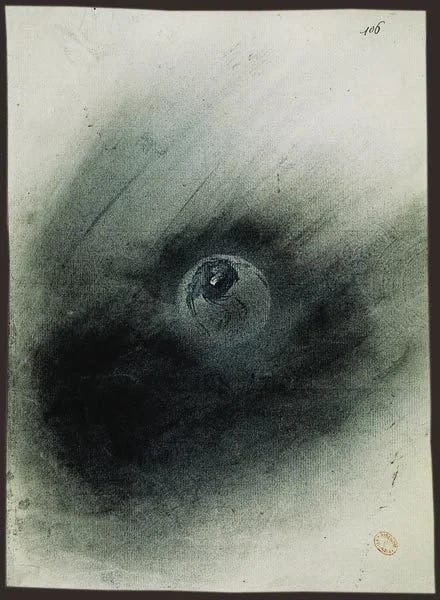
Eye planet, sketch by Victor Hugo (1857)
Two things stood out with regards to last week’s release of the UFO-files. One, the images proved wildly insubstantial, leading to feverish speculation instead of certainty. One can only suspect that this was precisely the point, to distract from the failed war on Iran, the Epstein files, and the daily outrages of life under the Trump regime. Secondly, the most popular response from young people as evidenced by countless comments online was, “why should we care? Does the existence of aliens mean that we don’t have to go to work tomorrow?”
This attitude of ironic indifference is the exact right response. When confronted with seemingly world-altering possibilities, one should always reply by saying, “yes, but how does that change our actual lived existence?” Moreover, it should be noted that the truly world-altering realities such as impending climate catastrophe, are always conveniently discarded by such fixations. The problem with the UFO files is not simply that they serve as a distraction, but that they are symptomatic of a broader post-literate society in which popular attention focuses solely on what can or cannot be seen. In the absence of any critical discourse apropos the structural conditions of our present moment, the interpretation of reality is reduced to the surface level of what is visible. Rather than being about transparency, such an emphasis on ‘seeing for oneself’ always implies a return to the realm of superstition.
Likewise, isn’t the same thing true for the impact of AI deep-fakes? The real problem is not that they disseminate falsehoods, but rather than in the age of AI we can no longer trust real images as such. Consider, for example, how images portraying dead children in Gaza are frequently dismissed as being AI-generated. The true impact of AI imagery is therefore not only that it spreads falsehoods, but that it undermines our trust in reality as such. Even when something is true, it is now easily dismissed as fake. This generalized suspicion therefore functions as a kind of repression-mechanism: when one sees something that startles or confronts, it is easily dismissed as fake.
This means that such suspicion always favors the hegemonic elite. For example, today it is impossible to imagine a situation like in 1968 when the infamous “Saigon execution” photo radically re-framed people’s perception of the war in Vietnam. Instead of living in a fantasy world that can be shattered by an image which shows the truth, the new fantasy is precisely a cynical one in which such horrors are seen as ‘how the world is’. This means that it’s not enough to say that we have become ‘desensitized’. No, something much more radical is taking place: the creation of a structural distortion of reality so as to suggest that atrocities and war-crimes are no longer the exception, but rather the norm. The widespread dissemination of horrifying imagery therefore does not ‘wake us up’ to the reality taking place in the world, but keeps us asleep, shaping a narrative in which such atrocities are seen as inevitable and the post-war consensus of human rights and just war is thrown out the window.
This is also why the Trump administration so readily shares AI-fakes, even when it appears to undermine their own version of reality. For example, following the failed assassination attempt at the White House Correspondent’s dinner, the White House released what were likely altered AI security footage of the shooter running past security. Why would they release fakes that seemed to serve no purpose other than to cause confusion? Of course the conspiratorial discourse that ensued is precisely the point. Which means that strictly speaking there is nothing to hidesave for the distortion of reality that such imagery invites. The confusion is the goal, as the Trump administration benefits from a generalized suspicion in which they can shape their own reality. The goal is not to reveal the ‘hidden’ truth, but to muddy the waters so much that even the truth becomes impotent. As Adorno put it, “The lie has long since lost its honest function of misrepresenting reality. Nobody believes anybody, everyone is in the know.”
Likewise, the widespread dissemination of fake AI satellite imagery has become a key propaganda tool in the (illegal) war on Iran. Key here is that the very ‘grainy’ nature of such imagery already lends itself to ambiguity, even when the image is real. Moreover, genuine deception is not even the point. Content-creators who spread such fakes know that they will gain much more attention and hence more revenue if the images are sufficiently ‘fake’-looking that they will be quickly uncovered and lead to online discourse. Here the ‘true’ intent of the fake is not to deceive, but to create confusion and controversy, which can then be monetized.
Another complication is that real video footage nevertheless comes to function as the worst kind of propaganda. For example, in 2025, when activists from one of the humanitarian flotillas sailing to Gaza were captured by Israeli forces and forced to watch deeply traumatic graphic footage of the atrocities of October 7th. Here the use of real footage nevertheless functions according to the logic of propaganda. Instead of examining the structural conditions, one is bombarded by the violent excesses of the horrors of the conflict from a one-sided position. Indeed, even the ‘liberal’ Zionist insistence that in order to understand what is going on in Gaza one must ‘understand their pain’ is deeply rooted in this kind of false logic in which images are made to ‘speak for themselves’. The truth is that in most cases the graphic depiction of such excessive violence functions as a distortion meant to obfuscate the structural conditions of normalized violence that form part of everyday life during the ongoing genocidal campaign in Gaza.
This is why Žižek, in his work on violence, argues that the elementary gesture of the critique of ideology should always be to refuse to partake in the immediate analysis of events as they appear. This is what he calls resisting ‘the hermeneutic temptation’. Instead of analyzing the graphic footage of violence and atrocities in their immediacy, one should instead take a step back and ask what is being obscured by the scandalous nature of such images. Whereas overt acts of violence appear to demand our attention, they nevertheless obscure the hidden and silent instances of (structural) violence that are nevertheless tacitly accepted as part of our everyday existence.
Meanwhile, the very excess of such readily available graphic imagery not only inures contemporary sensibilities to such atrocities, but also leads to a kind of generalized fundamentalist cynicism exploited by tech companies such as Palantir that push for the rapid expansion of AI into global warfare. The cynical argument is that since others are doing it, so should we. In the global arms-race, artificial intelligence therefore functions in a uniquely dual capacity, both shaping the perception of war in its own image, inasmuch as it creates the ideological conditions for its own perpetuation. The distortion that takes place is therefore always one that benefits those in power, as it suggests that their own inhuman and illegal actions are in fact nothing but a tacit admission that “this is how the world works.” Anyone who makes the argument against AI is then easily dismissed as a cook, a naive idealist, or someone working for the enemy. Indeed, just last week the Trump administration released its counter-terrorism report in which it identifies the targeting and elimination of leftists and other perceived internal enemies as a key priority, effectively rendering its political opponents de facto enemies of the state, with the implication that any criticism of the Trump administration can be seen as amounting to terrorist activity.
In such times how does one resist? Or perhaps the question should be inverted: “in such times, how does one not resist?” The first thing to do is to realize that there is no amount of ‘truth’ that will by itself get rid of those in power or convince those who support Trump to change their minds. This is why even though I support the release of the full and unredacted Epstein files, I don’t believe that this will necessarily change anything. Indeed, whilst we should demand justice for the victims, the oftentimes lurid fixation with the Epstein files remains to my mind another symptom of our contemporary fixation on the visual. In this sense, the fascination with the Epstein files remains within the logic of the UFO-files. The desire to ‘reveal the truth’, is strictly speaking not a genuine threat to the existing hegemony, but rather a symptomatic expression of it. In fact, one imagines that if Trump were not so personally involved in the Epstein files he would be using it to his political advantage.
Secondly, this is why I remain committed to what might be called a philosophical or critical truth-procedure, one that does not look for a hidden truth but which seeks to discern the truth revealed within the emerging symptomatic distortions of the present. This means eschewing the hunt for the truth ‘out there’, in favor of a critical inquiry into the formal logic of our contemporary immoral ethics as such. Or, to cite Walter Benjamin, “truth wants to be startled abruptly, at one stroke, from her self-immersion, whether by uproar, music, or cries for help.” This is what might be called the project of dialectical critiquea truth-procedure that takes into account all the morbid symptoms of our emerging present. A truth worth its name.
DOCUMENTED REFERENCES
Exploring Documented Records
Public interest in the Epstein case continues not only because of court proceedings and testimonies, but also due to the growing body of documented records that help researchers and readers understand the broader context. Beyond legal files and media reports, some independent projects have organized publicly available data connected to Epstein’s activities.
One example is a structured archive of documented Amazon order records, where purchases are cataloged with dates and product details. While individual items do not prove wrongdoing on their own, examining documented information alongside established facts helps paint a clearer picture of the environment and circumstances surrounding the case.

Browse the structured archive of documented order records
For readers looking to review primary-source style data rather than interpretations, exploring compiled records can provide additional context to the broader discussion.