Jeffrey Epstein (second from left) at a dinner party he hosted with scientists (Alan Dershowitz, Lawrence Summers, Seth Lloyd and Marvin Minsky) at Harvard University, September 9, 2004
Foto ANP / Polaris Images
This page is a visual research index of consumer products referenced in publicly released records describing Amazon orders associated with Jeffrey Epstein. Items below represent modern equivalents for contextual reference.
What did Jeffrey Epstein want from scientists? And what did they want from him? Released documents, the much-discussed Epstein Files, show that the convicted sex offender had ties to numerous politicians, artists and royals, as well as a range of scientists, before and after his first conviction in 2008. Epstein, who was found dead in prison in 2019, funded research, entertained scientists with dinners and plane trips and eagerly discussed genetics, consciousness and the future of humanity.
After becoming filthy rich with often puzzling financial services, the former math teacher quickly began building a collection of scientists. He was able to draw on the network of his ex-girlfriend and accomplice Ghislaine Maxwell (who is now serving a twenty-year prison sentence). Her father, the media magnate Robert Maxwell, owned, among other things, the scientific publisher Pergamon Press (sold to Elsevier in 1991), which published around seven thousand titles over the years. Also helpful was another gifted networker, New York literary agent John Brockman. He was host and founder of the online literary salon The Edge Foundation, a club “for exciting ideas at the intersection of science, technology and culture.” Epstein donated tons to the foundation and paid for Brockman’s dinners at TED conferences, a trendy gathering place for intellectuals influencers.
With success: the now released documents show that Epstein managed to establish and maintain close contacts with many dozens of scientists. They asked him for advice, he helped them find contacts and he donated to research. Before he fell from grace, his circle of acquaintances included such luminaries as Nobel Prize winner Murray Gell-Mann, discoverer of the quark, physicist Stephen Hawking, cognitive psychologist Steven Pinker and Harvard mathematician Martin Nowak. In those contacts, it was often Epstein who took the initiative and sought contact or linked people together. None of those scientists have been linked to Epstein’s crimes.
Scientists looking for funding for their research were easy prey for Epstein. He donated nine million to Harvardwhere he was in 2005 fellow became a guest researcher. The university refused a donation after his conviction in 2008. MIT in Massachusetts received about $800,000 from him between 2002 and 2017, much of it after that initial conviction for prostitution of minors. The exclusive Santa Fe Institute also received money ($25,000). The University of Arizona only canceled another annual conference on the study of cognition and consciousness (one of Epstein’s hobbies) after the organizing professor admitted that the fallen billionaire had donated $50,000 to a previous conference in 2017.
For scientists, dealing with Epstein held the promise of conversation with famous colleagues, connections and money, but who knows, also that of professional fame. Most scientists spend their lives publishing specialist articles for an often tiny audience, but the Academy is also home to a bestseller culture: ‘great books’ that sometimes turn an author into a global celebrity in one fell swoop. Of the stature of Steven Pinker – not coincidentally also a scholar in it Environment from Epstein. Pinker, who once accompanied Epstein on his plane to a TED conference, says he “immediately hated” the “wise guy and dilettante.” Earlier he mentioned Epstein in The New York Times already “an intellectual fraud,” a poser who “could abruptly change the subject in a conversation or dismiss a comment with an adolescent joke.”
Jeffrey Epstein (second from left) at a dinner party he hosted with scientists (Alan Dershowitz, Lawrence Summers, Seth Lloyd and Marvin Minsky) at Harvard University, September 9, 2004
Foto ANP / Polaris Images
Epstein’s scientific interests may have had a high Willie Wortel content, but many scientists, accustomed to a frugal life in university offices, would have been impressed by his almost caricatured ambiance of unbridled wealth, luxury and global jet set connections. “He was after them, and they were after him,” summarized Scientific Americaneditor Dan Vergano put it together in a podcast by The Guardian.
His contacts with leading scientists brought Epstein even more connections and influence, but also a reputation bonus. With his selfless donations he was able to dispel the bad smell about his person and pose as a philanthropic universal man. Things are now different for the scientists involved: they appear to have engaged with a sexual predator who used women and often underage girls as disposable wipes. Most who had or maintained contact with Epstein after his first conviction in 2008 now swear up and down that they knew nothing about his large-scale sexual abuse or trafficking in women.
However, the documents sometimes reveal sexist ‘boys among themselves’ behavior, with bad ‘jokes’ or asides about women – Epstein’s scientific circle was a men’s club. Virologist Nathan Wolfe of Stanford (mentioned 589 times in the documents) Epstein asked in 2013 whether he could finance microbiological research into student sexual behavior to test “our horny virus hypothesis.” Wolfe swears never to have received money from Epstein and regrets his contact with him. Astronomer Lawrence Krauss, who received $250,000 from him, also defended Epstein after his conviction in 2008. He was reprimanded at the University of Arizona after allegations of misconduct. The prestigious Harvard has started an investigation into Epstein’s ties with economist Lawrence Summers, former Minister of Finance and former chairman of the university, who maintained intensive contact with Epstein.
In his mating dance around famous scientists, Epstein was not just about money and reputation. Like some other super-rich, like the tech billionaires in Silicon Valley, the shady financier was gripped by “Big Questions.” In his mansion and on his private island he brought together ‘top minds’ (m) to discuss the nature of consciousness, the origins of the universe, the future of humanity. Genetics, AI and cognitive sciences were his special interests. A large portion of his donations to Harvard were earmarked for that university’s Evolutionary Dynamics Program.
That interest had a sinister connotation. Epstein looked for ways to use technology and artificial intelligence to breed ‘better’ people, himself first. At dinners he talked about a plan to work on his ranch near Santa Fe, New Mexico An baby farm to set up where women would be impregnated with his seed, reported The New York Times in 2019. He is said to have gotten the idea from an older, discontinued initiative to set up a sperm bank for Nobel Prize winners. He was also interested in cryonics, the science fiction idea that you can freeze human organs and bring them to life later. Epstein, sometimes described as a megalomaniac or narcissistic psychopathwould have wanted his head and penis frozen. In the meantime, he stayed in business. A Dutch entrepreneur with plans to develop a ‘pleasure pill’ for women asked Epstein as an investor – but received no response.
:format(webp)/s3/static.nrc.nl/wp-content/uploads/2026/02/13112029/130226WET_2031506178_EpsteinWetenschappers2.jpg)
Up ranch near Santa Fe in New Mexico, Jeffrey Epstein wanted one baby farm to establish where women would be impregnated with his seed.
AP photo
Epstein was certainly not alone in his pseudoscientific fascinations. Transhumanism, the desire to breed technologically enhanced humans or even achieve immortality, is a trend among exempt futurists and tech billionaires. Sometimes this is accompanied by apocalyptic speculation about nuclear or other disasters, which only an elite can avoid. Epstein donated to the World Transhumanist Association, an association for people who “dare to think visionarily about the next steps of humanity.” If fellow at Harvard, Epstein wanted, he wrote in his application to the university, to investigate group behavior and ‘social prostheses’: using other people’s talent to increase one’s own intelligence or regulate emotions. A striking summary of his cold, instrumental view of humanity, according to the Scientific Americanthat are connections with scientists explored.
For some people around him, it went too far. The lawyer Alan Dershowitz, one of Epstein’s lawyers when he was charged in 2008 but later estranged from him, told The New York Times that he was shocked when the financier explained his eugenic ideas to him. They reminded him of Nazi practices. It is unclear whether Epstein’s fantasies and views on eugenics influenced the scientists with whom he interacted. It appears from the documents that they were more concerned with his financial support and connections.
:format(webp)/s3/static.nrc.nl/wp-content/uploads/2026/02/13112031/130226WET_2031506178_EpsteinWetenschappers3.jpg)
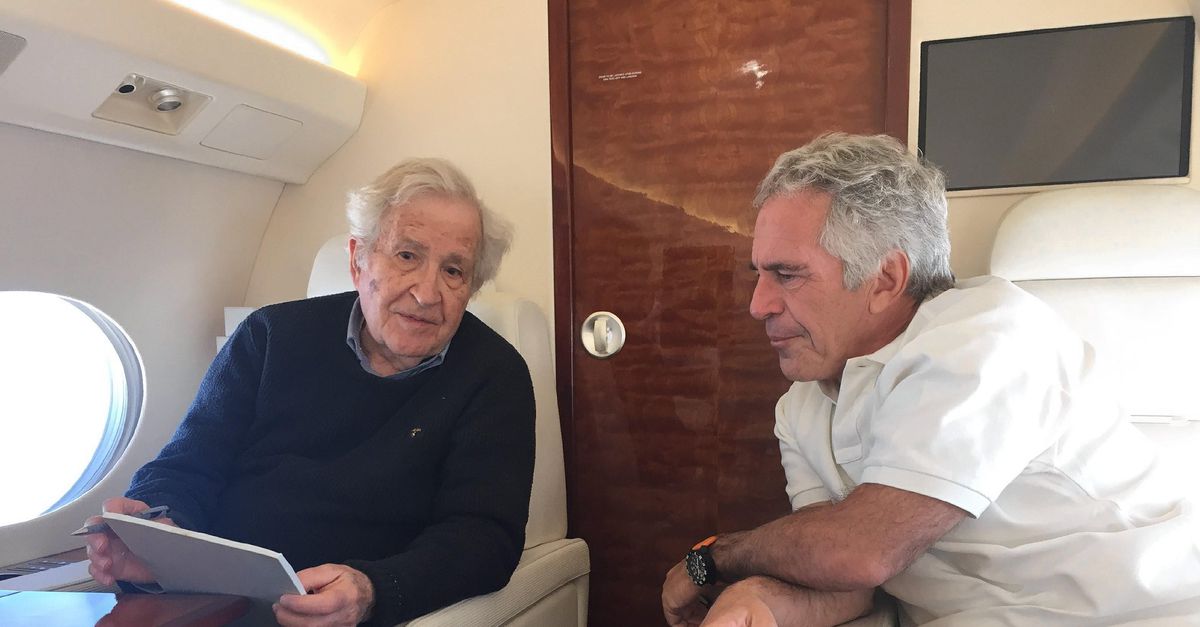
Noam Chomsky in Jeffrey Epstein together on a flight, found as an undated photo in the Epstein Files.
Photo ANP/Zuma Press
A special case in the collection of academics that Epstein has built up over the years is the world-famous linguist and public intellectual Noam Chomsky. His years of amicable dealings with Epstein have come as a shock to progressive circles where Chomsky is admired for his criticism of the American political and financial establishment. In a long series of books, the 97-year-old Chomsky has denounced American imperialism since the 1960s and holds the West responsible for the war in Ukraine.
The documents show that Chomsky not only corresponded with Epstein, but was also a guest at his New York mansion and flew with him on his private jet. Photos of the two on board surfaced, busy talking. When Epstein canceled a visit to the couple’s home at the last minute by email, Chomsky responded with disappointment that his wife his “favorite dessert” had made. After Epstein again came into the crosshairs of the Justice Department in 2019 Chomsky wrote to him that it was “terrible to see how you are treated by the media and the public” and advised him to ignore the fuss. Chomsky criticized the behavior of the “vultures” and the “hysteria” about abuse of women that was at a peak with #MeToo. So much so that, he said, “questioning an accusation now counts as a worse crime than murder.”
In a recent statement the couple regrets the ties with Epstein as a “serious mistake” and apologize. He manipulated them, according to wife Valéria (Chomsky himself no longer writes after a stroke in 2023). The two never visited his island and “knew nothing about what happened there,” she assures. But what did Chomsky gain from Epstein? He used him as a source, is one explanation: the financier gave him insight into the modern financial world. But Epstein also helped the Chomskys with their personal accounting. According to his wife, he fixed a gap in Chomsky’s pension provision that caused the linguist “a lot of stress,” the statement said.
DOCUMENTED REFERENCES
Public interest in the Epstein case continues not only because of court proceedings and testimonies, but also due to the growing body of documented records that help researchers and readers understand the broader context. Beyond legal files and media reports, some independent projects have organized publicly available data connected to Epstein’s activities.
One example is a structured archive of documented Amazon order records, where purchases are cataloged with dates and product details. While individual items do not prove wrongdoing on their own, examining documented information alongside established facts helps paint a clearer picture of the environment and circumstances surrounding the case.
Browse the structured archive of documented order records
For readers looking to review primary-source style data rather than interpretations, exploring compiled records can provide additional context to the broader discussion.